Former Saint Ignatius Captain Will Karnick Motivated To Be A Professional Triathlete
By Ross Forman
Will Karnick was 9 when he tore his ACL playing football and needed surgery – and that’s when he started watching videos of athletes crossing the finish line at the Ironman World Championship in Kailua‑Kona, Hawaii, widely regarded as the most prestigious long‑course triathlon in the world.
He told his dad that, one day, he too would be an Ironman.
“At the time, I had no idea what that would take or how far away that dream really was. Years later, after moving on from hockey and discovering running, I decided to see if I could make it happen. I went from running my first marathon to taking on triathlon, qualifying for the Ironman World Championship, and eventually racing in Kona,” he said. “I’m proud of what I’ve accomplished, but I also know I’m just getting started. I want to continue finding out what I’m capable of, pursue the goal of becoming a professional triathlete, and use the process to become a better person.
“I hope my story shows that you don’t have to be the most talented person in the room or have everything figured out from the beginning. You just have to be willing to work, keep learning, not be afraid to fail, and give yourself the chance to find out what is possible.”
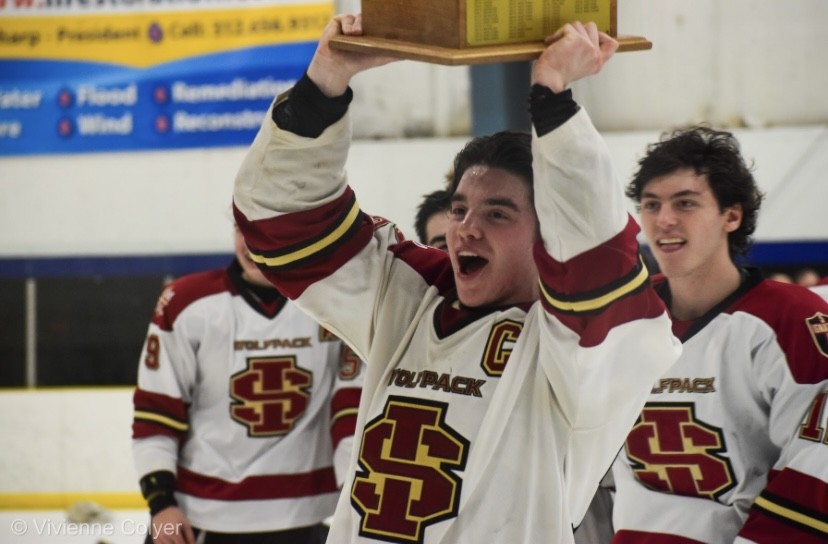
Karnick, 22, a Chicago resident, played three years of varsity hockey at Saint Ignatius, where he was captain for the 2021-22 season and a Kennedy Cup champion for the first time in school hist ory that Ignatius was the Chicago Catholic Hockey League playoff champion. Karnick also was a CCHL all-star as a senior who graduated in 2022, then went on to Indiana University, where he played one season for the Hoosiers’ club program.
“My experience (playing at IU) was similar to high school: I was fighting for a spot in the lineup and had to earn my opportunities,” he said. “Over time, I realized I wasn’t enjoying hockey the same way I had in high school. I was ready to try something different and find another outlet for the competitive drive and work ethic that hockey had given me. I started running and quickly discovered that endurance sports offered a new way to challenge myself and see how much I could improve through consistent work.
“I don’t play (hockey) anymore and haven’t skated in a while. Hockey is still a huge part of who I am, and I have so much love for the game and the people I played with. However, I’m pursuing a different dream now: becoming a professional triathlete.”
His grind in the endurance sports world landed him in Kona, Hawaii on October 10 and, after nine-plus hours, he heard those priceless six words: “Will Karnick, you ARE an Ironman.”
“The first time you hear those words, it honestly doesn’t feel real,” he said. “It’s something you dream about and work toward for months, sometimes years, and then suddenly you’re standing at the finish line hearing someone say it.
“Becoming an Ironman happens long before those words are spoken. It happens during the months of training, the early mornings, the long workouts, the sacrifices and the days when you don’t feel like going out the door but do it anyway. It happens when you overcome setbacks and keep showing up even when progress feels slow.
“The finish line is the moment everyone sees, but it represents so much that nobody else sees. When I hear those words, I think about all the work that went into earning them and how fortunate I am to have the ability and opportunity to pursue something like this. It’s a moment I’ll never take for granted, especially because of how long I’ve dreamed about becoming an Ironman and racing in Kona.”
Karnick has completed five marathons, three full Ironman-distance triathlons, and one Ironman 70.3. His best marathon time is 2:39:49. He completed Ironman Wisconsin in 2025 in 10:22, Ironman Texas in 2026 in 9:13, and the 2026 Ironman World Championship in Kona in 9:24:24. His Ironman 70.3 finish was in Rockford, where he finished in 4:09.
A full Ironman consists of a 2.4-mile swim, a 112-mile bike ride, then a 26.2-mile marathon. An Ironman 70.3 is half those distances.
“I take that goal (of being a professional triathlete) seriously and try to do everything I can to give myself the best chance of achieving it,” he said. “That means being intentional about my training, recovery, nutrition and the decisions I make outside of the sport. At this point, I’m also mindful of the risk of injury and want to give myself the best opportunity to continue developing as a triathlete.
“Even though I don’t play anymore, I don’t feel like I’ve left hockey behind. The lessons I learned, the relationships I built, and the mindset I developed are all things I carry with me every day. The sport has changed, but the way I approach competition and hard work hasn’t.”
HOCKEY LIFE
Now a tax consultant at Deloitte, Karnick hasn’t forgotten the countless games, goals and assists during his hockey run, including awards, such as the Saint Ignatius Coaches Award as a senior – for demonstrating sportsmanship, leadership and positive contributions to the growth of the team and his teammates on and off the ice.
“Without a doubt, winning the Kennedy Cup for the first time in Saint Ignatius history,” was a career highlight, he said. “We lost to Benet Academy in the championship the year before, so coming back the following season and beating them to win it was incredibly rewarding. We had a group of guys who were determined to finish what we started, and everyone understood what that championship would mean to the program. Being able to accomplish something that had never been done before at Ignatius with a group of teammates who felt like brothers is something I’ll always remember.”
Karnick tagged himself as “a third-line grinder.” He was never the most skilled player on the ice, nor the player who long was counted on to score goals. He was, though, one of the hardest-working players on the team, always.
“I never paid as much attention to goals, assists or points as I did to blocked shots and faceoff wins. I wanted to block more shots than anyone on the ice, even as a center, where you don’t necessarily have as many opportunities to do that. I wanted to win the little battles that might not show up on a scoresheet but could make the difference in a game. I loved playing defense, helping our defensemen and goalie, taking hits, and coming off the ice with bruises if it meant I had done my job for the team.”
As a sophomore, he was in and out of the Ignatius lineup – and that lit a fire in him.
“I never wanted to feel the disappointment of not being able to dress for a game again, so I knew I had to find ways to contribute even when I wasn’t producing offensively,” Karnick said. “I always wanted to be a goal scorer, but I understood that I might not have the same natural skill as some of the guys around me. What I could control was how hard I worked, how prepared I was, and how much I was willing to sacrifice for the team.
“Even when I became captain (as a senior), I still felt like I had to earn my spot. I never took a game or a shift for granted. I learned that you don’t have to be the most talented guy on the ice to make a difference. Sometimes your biggest contribution is doing the difficult things that allow your teammates to shine.”
One shining moment for Karnick was during a 2021 semifinal game against York in the annual O’Grady Thanksgiving Tournament, host by Loyola Academy.
“We were up 1–0 with about two minutes left when one of our teammates took a penalty,” Karnick said. “York pulled its goalie, so we had to survive a six-on-four for the remainder of the game. We knew that if we could hold on, we would get another shot at Loyola in the championship, a team we had historically struggled against and really wanted to beat.
“During that penalty kill, I blocked five consecutive shots in about two minutes. Every time the puck came toward the net, I tried to get in front of it. We managed to close out the game, and the place was going crazy. The energy in the building was incredible, and I remember feeling like that shift gave our team a spark. It was one of those moments when everyone was willing to sacrifice for one another, and you could feel how badly we wanted to win.
“That shift represents the kind of player I always tried to be. I might not have been the guy scoring the goals, but I was willing to put my body on the line to give our team a chance to win. Sometimes the plays that mean the most are the ones that never show up on the scoresheet.”
Karnick was the Ignatius captain as a senior, an honor not given based on how many goals scored, but rather, “how I showed up, how I treated people, and how I carried myself on and off the ice.” He led by example: working hard, showing up on time, wearing a tie to school on game days, and helping keep his teammates focused when there were plenty of distractions that came with being in high school.
“That experience changed how I viewed leadership,” Karnick said. “You don’t need to be the most talented person in the room to set a standard. You have to be consistent, hold yourself accountable, and be willing to do the things you ask others to do. Winning the Kennedy Cup that senior year made everything we had worked for feel worthwhile.
“Hockey taught me that there are a lot of ways to make a difference, even if you’re not the most skilled person on the team. You can motivate people, make your teammates better, and contribute to something bigger than yourself without being the leading scorer or getting all the recognition.
“When I was playing, I started to understand that the guys scoring goals were often able to do what they did because other guys were blocking shots, winning battles, and taking hits for them. If everyone on a team wanted to be the skill guy, we wouldn’t have gotten very far. Every role matters, and a team only works when everyone is willing to embrace theirs.”
Karnick added: “The other major thing I took away was the importance of the people around you. I learned a lot from the older players I looked up to and from my coaches, who taught us far more than just how to play hockey. They emphasized hard work, doing things the right way, being appreciative of what we had, giving back and committing ourselves to something bigger than ourselves.”
Through hockey, Karnick learned of the three C’s: care, character and compete.
“Those values have stuck with me long after leaving the locker room,” he said. “They influence how I approach my career, my relationships and my training. Hockey helped shape the way I view challenges and taught me that success isn’t just about what you accomplish individually. It’s also about the people you help along the way.”
Karnick’s hockey career included year skating for the Chicago Stallions and the Chicago Jets, too.
“Winning the Kennedy Cup and beating New Trier Green for the first time in school history during my senior season are two of the biggest highlights,” of my hockey career, he said. “But some of my favorite memories have very little to do with the games themselves. I always loved the bus trips to play out-of-state teams. We had a great group of guys who knew how to work hard but also how to have fun. Some of my favorite memories were the 6 a.m. practices before school. There was a different kind of energy at those practices, knowing everyone had gotten up early because we all wanted to get better.
“More than anything, I remember the locker room. The jokes, the conversations, the bus rides and the relationships we built made the experience special. When you’re part of a team like that, the guys you lace up with stop feeling like teammates and start feeling like brothers. Those relationships are a big reason why hockey will always mean so much to me.”
Karnick said hockey taught him how to handle adversity. “You learn what it feels like to get knocked down, deal with disappointment, and find a way to get back up,” he said. “You also learn how to win and lose with a group of people, put your ego aside, and make sacrifices for the good of the team.
“I learned that the most talented person doesn’t always win. Talent matters, but it only takes you so far if you’re not willing to work for it. I have always believed that hard work beats talent when talent doesn’t work hard, and that’s something I continue to apply in life.”
Hockey taught him accountability. “When you’re part of a team, your decisions affect more than just you. Your teammates count on you to show up prepared, do your job and give your best effort,” he said. “I try to bring that same mindset into everything I do, whether it’s my career, training for an Ironman, or being there for the people around me.”
Karnick’s advice for today’s high school players is simple: keep the fire lit. “For some people, that means continuing to play hockey. For others, it means finding something completely different that challenges them and gives them a reason to keep improving,” he said. “Don’t think that your best days have to be behind you just because your high school hockey career ends. There are so many ways to keep growing, competing and discovering what you’re capable of. You might find something you never expected to love, just as I did with running and triathlons.
“I would also tell them to listen to their gut, pursue what genuinely excites them and be willing to say ‘yes’ to opportunities. You don’t always know where a decision will lead, and you don’t need to have your entire life figured out at 18 or 22. Put yourself in situations where you can learn, meet people and challenge yourself. You never know which opportunity might change your life.
“Most importantly, carry the lessons you learned (in) hockey into whatever comes next. Work hard, be a good teammate, do things the right way, and don’t be afraid to start at the bottom and earn your place. There is always another level you can reach if you’re willing to put in the work.”
AFTER HOCKEY
After his freshman year of college, Karnick was ready to move on from hockey and try something different. Running was that outlet. About six months after starting to run seriously, he completed his first marathon in 2:57 and qualified for the prestigious Boston Marathon. “That experience opened my eyes to what was possible,” he said. “I continued running throughout college and eventually brought my marathon time down to 2:39:49, averaging just over six minutes per mile for the entire race.”
He then transitioned to triathlon.
“I love that triathlon gives me the opportunity to keep learning, improving and testing my limits. There’s always another weakness to work on, another level to reach and another way to get better,” he said. “Qualifying for Kona at Ironman Texas was a huge milestone because it meant I had earned the opportunity to compete against the best triathletes in the world. Being able to take that opportunity to the World Championship and finish 11th in my age group made the experience even more meaningful.
“Kona was an incredible experience, but it also was, by far, the hardest thing I’ve ever done. It was hot, humid, windy and every bit the World Championship you would expect. The course is demanding even in good conditions, and on race day, the weather made everything more challenging. It was pouring rain when I woke up. By the time we reached the start of the swim, it was extremely humid and the ocean was rough. The swells were huge and the water was choppy enough that the swim was much slower than expected. There were athletes dealing with seasickness; it was one of the toughest swims I had experienced.”
The Kona bike course also was a challenge. “You’re riding along the highway surrounded by lava fields, with virtually no shade, and you have to manage the heat while dealing with strong crosswinds and gusts,” he said. “There were many crashes because some athletes struggled to control their bikes in the wind.”
To wrap the day, it was the 26.2-mile run, “which is where the race really tested me,” he said. “The wind that had been hitting me on the bike was no longer there to provide relief, and the sun was beating down. I was completely exhausted on the run. There were moments when I had to simplify everything and focus on putting one foot in front of the other. I kept telling myself that as long as I was moving forward, I was still in the fight. At that point, you can’t think about the miles you’ve already completed or how many you still have left. You focus on the next step and find a way to keep going.
“What made Kona so meaningful was that it taught me something about myself that I couldn’t have learned in an easier race. I learned how I respond when things don’t go to plan, when I’m physically exhausted and when I have to dig deeper than I thought possible. It was an incredible experience, and I’m grateful I had the opportunity to compete there.
“It’s hard to be disappointed when you cross the finish line at the Ironman World Championship. I went into Kona without knowing exactly what to expect, especially given the conditions, and I gave the day everything I had.”
Karnick finished third among U.S. athletes in his age group.
And yes, hockey helped him in Hawaii.
“Hockey instilled a work ethic and a willingness to do whatever was necessary to improve,” he said. “I was never the most naturally skilled player, so I learned early that if I wanted to earn my place, I had to be willing to put in more work and find ways to contribute that other people might overlook. That mindset translates directly to triathlon. There are so many hours of training that nobody sees, and improvement comes from consistently doing the work, even when it isn’t exciting or immediately rewarding. You can’t skip the hard days and expect to get the same results. You have to be disciplined, patient and willing to keep working at the things you’re not good at yet.”
Karnick said there are many similarities between hockey and triathlon, even though they look like completely different sports. “The biggest is that both reward the people who are willing to put in the work when nobody is watching,” he said. “In hockey, I learned that games aren’t won just by the most skilled players or the guys who score the most goals. They’re also won by the guys who block shots, win faceoffs, finish their checks and do the little things that might never show up on a scoresheet. Triathlons are the same. Nobody sees all the early mornings, long workouts, sacrifices and days when you have to get out the door when you don’t feel like it. But those are the things that determine what happens on race day.
“Another similarity is learning how to compete when things aren’t going your way. In hockey, you might make a mistake, get scored on, or have a bad shift, but you have to move on because the next shift is coming. In an Ironman, you might have a difficult swim, struggle on the bike, or hit a wall during the marathon, but you still have to find a way to keep going. You can’t control everything that happens, but you can control how you respond.
“The other big similarity is that neither sport is just about you. Hockey taught me to put my teammates first and do my job so the people around me could succeed. Triathlons are more individual, but the people who support you, train with you, coach you, and believe in you are a huge part of the journey. I’ve also found that the triathlon community has the same kind of camaraderie I loved about hockey. People are competing against one another, but they’re also genuinely excited to see each other succeed.
“Both sports taught me that you don’t have to be the most talented person in the room to accomplish something special. You have to be willing to work, stay disciplined, do the little things right, and keep showing up.”
Karnick is set to race Ironman Texas in April – and he’s shooting to break the nine-hour barrier and take another step toward earning a professional triathlon card and qualify for the 2027 Ironman World Championship.
The local hockey community will, virtually, support Karnick in Texas, just as it did in October some 4,000-plus miles away in Hawaii.
“The hockey community and the triathlon community share a similar spirit. Both are full of people who understand how much work goes into competing and who genuinely want to see others succeed,” he said. “Even though I no longer play hockey, I still feel connected to that community, and it’s incredibly rewarding to have people from that part of my life supporting me in this new pursuit.
“It also reminds me that the relationships you build through sports last long after the games and races are over. Those connections are one of the best parts of being an athlete.”